


The History and Evolution of the Thobe
The thobe, an ankle-length garment worn by men across the Arab world and other Muslim-majority regions, is more than just clothing. Its origins date back to pre-Islamic Arabia, where it was designed for the harsh desert climate, offering protection from heat and sandstorms. Over time, Islamic teachings shaped its design, embedding values of modesty and simplicity. Today, the thobe remains a symbol of faith and identity, evolving in materials, styles, and uses while maintaining its timeless essence.
Key takeaways:
- Origins: Practical desert wear made from wool or camel hair.
- Islamic Influence: Emphasised modesty and simplicity, with white being a preferred colour.
- Regional Styles: Variations like the Emirati kandura, Saudi thobe, and Moroccan djellaba reflect local customs.
- Modern Trends: improved fabrics, tailored fits, and online accessibility have brought the thobe into contemporary fashion.
- Cultural Significance: Continues to serve both religious and daily purposes, bridging tradition with modern needs.
From its practical beginnings to its current role in modest fashion, the thobe’s journey showcases its enduring relevance.
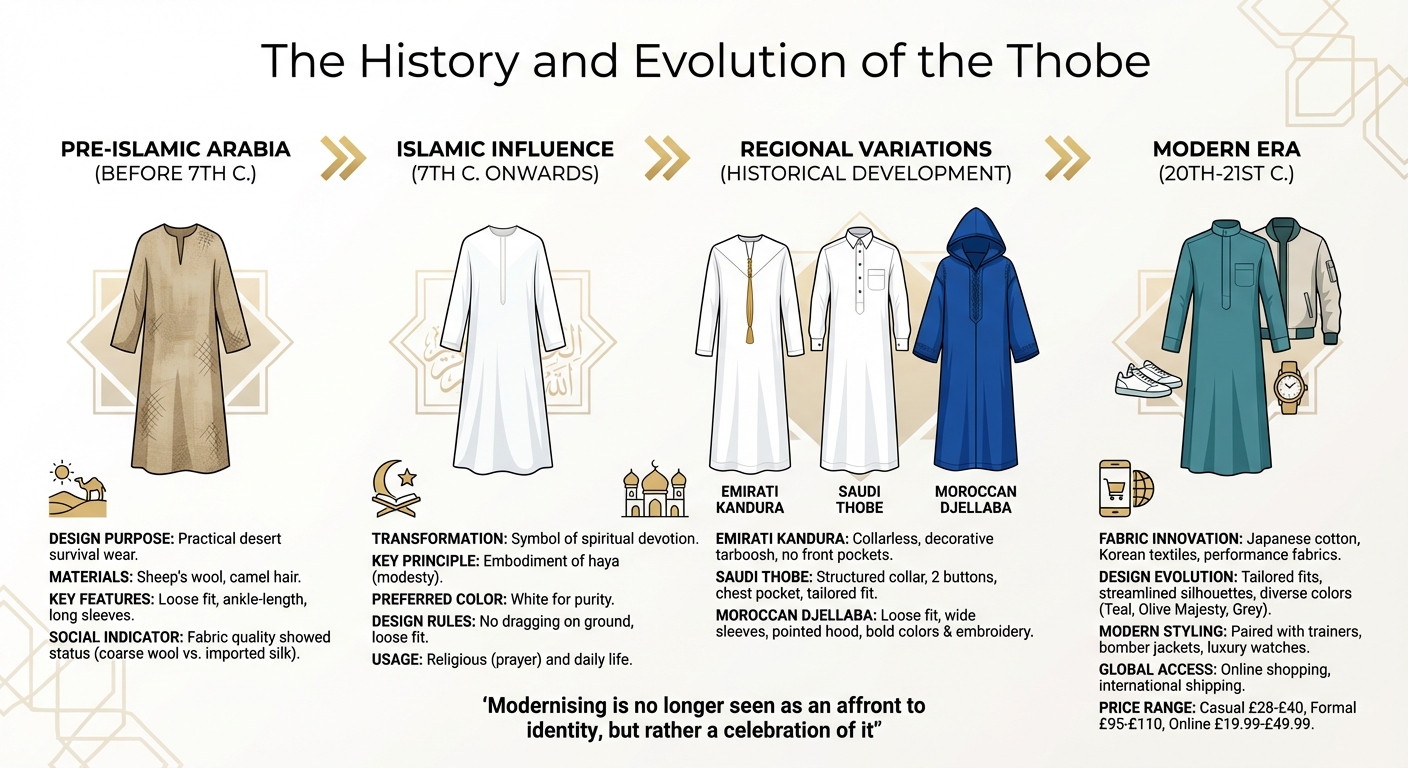
Evolution of the Thobe from Pre-Islamic Arabia to Modern Day
Origins in Pre-Islamic Arabia
Long before the advent of Islam, the thobe was a practical solution to the harsh desert environment of the Arabian Peninsula. With its extreme heat, relentless sandstorms, and limited access to water, the region demanded clothing that could protect the body while remaining functional. As one source aptly describes:
"The challenging environment of the Arabian Peninsula, characterized by scorching sun, sandstorms, vast deserts, and scarce water sources, necessitated ingenious adaptation for survival."
Remarkably, the basic design of the thobe has endured for thousands of years. Dr Laila Al Bassam, a Professor specialising in traditional Arab costumes and textiles, refers to this as "basic human design". Arab historian Ibn Khaldun categorised historical clothing into two main types: the wrapped garment (Izar) and the cut garment. He noted:
"over history humans developed two types of dress: one that is wrapped ('Izar') and one that is cut. The Thobe, which we still wear today, is the latter."
This "cut" design was a significant step forward in tailoring, moving beyond simple draped fabrics to create a garment that was not only functional but also durable.
Design for Desert Living
The thobe's loose fit was key to its practicality, allowing air to circulate and helping the body stay cool in the desert heat. Its full-length design, with ankle-length hems and long sleeves, provided essential protection from the sun's intense rays, preventing sunburn during long journeys. Early versions of the thobe were made using materials readily available in the region, such as sheep's wool and camel hair. Camel hair, known for its light brown hue, was especially valued. Craftsmen improved the fabric by soaking, drying, and stoning it to achieve a smooth finish.
The thobe's design also complemented traditional headwear. The white ghutra reflected sunlight, while its hood could be adjusted to shield the face during sandstorms. The shemagh, a similar head covering, has roots tracing back to Sumerian priests, with the term "ash makh" meaning "big head cover" in ancient Sumerian. Even the iqal, the cord securing the headwear, had a practical origin. Historian Haydar Al-Nasser explains:
"The word 'iqal' comes from the Arabic word 'aqil,' which means to tie something so it doesn't get lost."
Traditionally, the iqal was a thick rope made from sheep's wool, doubling as a tool for tethering camels.
While the thobe's design was primarily focused on practicality, subtle differences in fabric and style often reflected a wearer’s social standing.
Social Status and Symbolism
Though the thobe's basic structure was universal across pre-Islamic Arabian society, fabric quality and stylistic details often revealed a person’s social rank. Those with limited means typically wore garments made from coarse, heavy wool, while wealthier individuals could afford finer materials like silk imported from Damascus. Tribespeople often wore plain or striped garments in black and white, but higher-ranking individuals favoured brighter colours such as red or green.
The bisht, a ceremonial cloak worn over the thobe, was a clear indicator of status and authority. Reserved for officials and prominent figures, it often featured gold or silver embroidery on the shoulders or intricate patterns around the neckline. Additionally, the placement of a dagger at the central belt carried cultural weight, symbolising masculinity and bravery.
This combination of practicality and symbolic detail laid the groundwork for the thobe’s evolution under the influence of Islamic traditions.
sbb-itb-81d10cb
Islamic Influence on the Thobe
As the thobe transitioned from its roots as a practical desert garment, the arrival of Islam in the 7th century gave it a deeper meaning. Islamic teachings reshaped its purpose, turning it into a symbol of spiritual devotion and moral values. The faith not only influenced its design but also standardised it across the Muslim world, making it much more than just clothing.
Modesty in Islamic Dress
Islamic principles transformed the thobe into an embodiment of haya (modesty), a central value in the faith. The Quran highlights the purpose of clothing, stating:
"O children of Adam, We have bestowed upon you clothing to conceal your private parts and as a fine adornment; and the clothing of righteousness, that is best."
This verse sets clear guidelines for what is considered appropriate attire. The thobe’s loose fit ensures it doesn’t cling to the body, maintaining modesty by avoiding the outline of one’s form.
The Prophet Muhammad’s guidance further influenced the thobe’s design. He encouraged wearing white for its simplicity and purity, discouraged garments that dragged on the ground - a practice called isbal, often linked to pride - and advised moderation in dress, saying:
"Eat, drink, give charity, and wear clothes without extravagance or pride."
Historically, Islamic scholars and jurists have favoured simple materials like cotton, linen, or wool for men’s clothing, reflecting humility and steering clear of materialism. Luxurious fabrics, such as silk, and those dyed with saffron were explicitly prohibited for men. Even colour choices carried weight - bright or intricate patterns were often avoided during prayer to maintain focus and minimise distractions.
This emphasis on modesty shaped not only religious rituals but also everyday dress, embedding these values into daily life.
Use in Religious and Daily Life
The thobe’s design is practical yet deeply connected to Islamic principles, making it suitable for both religious and daily activities. Its loose, ankle-length structure supports the physical movements of Islamic prayer (Salah) - standing, bowing, and prostrating - while ensuring the body remains modestly covered. The breathable fabric adds comfort, especially during extended prayer sessions.
Outside the mosque, the thobe became a staple across the Arabian Peninsula, symbolising piety and equality. It served as a “uniform of piety,” helping to minimise visible differences in wealth and social status, fostering a sense of unity within the Muslim community.
Its simplicity aligns with the Quranic call to dress modestly for worship without excess. Wearing a clean, white thobe for religious events such as Jummah (Friday prayers), Ramadan, or Eid reflects the sunnah - the practices of the Prophet Muhammad - and honours his modest appearance.
Despite regional variations influenced by climate and local customs, the thobe remains a timeless garment in Islamic societies, seamlessly blending spiritual significance with everyday utility. Its enduring presence is a testament to its role as both a practical and symbolic piece of attire.
Regional Variations Across the Arab World
While Islamic principles give the thobe its spiritual significance, its physical design has been shaped by geography and local traditions. From the Arabian Gulf to North Africa, each region has put its own stamp on this attire, influenced by climate, customs, and aesthetic preferences. These subtle distinctions are more than just fashion - they’re markers of identity across the Muslim world. Let’s dive into some of the most notable regional styles, including the Emirati kandura, the Saudi thobe, and the North African djellaba.
The Emirati Kandura
The Emirati kandura is celebrated for its clean and simple design. Unlike other Gulf styles, it stands out with its collarless neckline, creating a sleek and streamlined look. Its most recognisable feature is the tarboosh - a decorative tassel that has evolved over time. Historically shorter and twisted, the tarboosh is now often longer and embroidered. Salem Al Mheiri, co-owner of Duca & Das, offers some insight:
"The tarboosh [a piece of fabric that looks like a tie and is unique to Emirati kanduras] was always there, but the design was different – it was shorter and started to get longer over time".
The kandura skips front pockets, adding to its uncluttered appearance. In the UAE, a white kandura paired with a white ghutra (headscarf) and black shoes is considered standard professional attire.
The Saudi Thobe
In contrast to the understated elegance of the Emirati kandura, the Saudi thobe offers a more structured and formal style. It features a prominent collar fastened with two buttons and includes a single chest pocket on the left side. The fit is typically tighter than other Gulf styles, giving it a polished, tailored look - a reflection of influences from Saudi imams in Makkah and Madinah.
Saudi thobes often include shirt-style cuffs on the sleeves, further enhancing their refined appearance. Instead of focusing on decoration, the emphasis is on high-quality fabrics and impeccable tailoring. During winter, darker, heavier fabrics like navy, brown, or black replace the lighter white cottons worn in summer.
North African and Moroccan Djellaba
The Moroccan djellaba (also known as jillabah or kaftan) takes a different approach, leaning towards comfort and practicality. Its loose fit, wide sleeves, and flowing robe-like shape make it ideal for everyday wear. The pointed hood, or cob, is its signature feature, offering protection from the sun and sand.
Unlike the Gulf’s preference for white, the djellaba embraces bold colours, stripes, and intricate embroidery. These decorative touches not only highlight the craftsmanship of the region but also maintain the modesty central to Islamic dress. Together, these regional variations show how the thobe continues to adapt, blending tradition with local influences to remain a cornerstone of Islamic fashion.
Changes in Fabric and Design
The thobe's evolution tells a fascinating story of how a traditional garment has adapted to meet the demands of modern life. What began as practical clothing for desert survival has transformed into a stylish piece that merges heritage with contemporary needs.
Early Fabrics and Local Materials
In its earliest forms, the thobe was crafted from natural fibres like cotton and linen. These materials were chosen for their breathability and ability to protect wearers from the harsh desert environment, where high temperatures and sandstorms were common.
During the early 20th century, trade routes began to influence thobe design, particularly in regions like Palestine. For instance, Palestinian thobes incorporated Syrian "saya" fabric, known for its striking gold and red hues, alongside Gaza's indigo "majdal" fabric. These garments combined various materials such as cotton, taffeta, atlas silk, and intricate silk embroidery. While white fabrics were favoured for their ability to reflect sunlight, darker colours were used in colder climates to provide additional warmth. These early choices in fabric laid the groundwork for later advancements in textile technology.
Modern Fabric Developments
The discovery of oil in the Middle East brought significant changes to thobe production. With technological progress came improved fabrics that were more durable and versatile.
Today, thobes are made from performance fabrics and luxurious silk blends that prioritise comfort. High-quality materials like Japanese cotton and Korean textiles are particularly popular for their excellent breathability, making them ideal for hot climates. Additionally, luxury cottons, corduroy, and midweight fabrics offer greater durability and structure compared to the simpler cotton and linen used in the past. This evolution in materials has elevated the thobe from functional attire to a symbol of identity, fashion, and status.
Current Design Trends
Modern thobes embrace refined tailoring and a sleeker silhouette. The heavy layering of the past has given way to streamlined designs with a tailored fit. Although white remains a spiritually significant colour - rooted in a hadith recommending it for clothing - today's thobes also include a wide range of colours such as Tropical Blue, Olive Majesty, and various shades of grey and teal.
Younger generations are reimagining the thobe by pairing it with modern accessories like trainers, bomber jackets, and luxury watches. Subtle design elements, such as variations in collars, cuffs, and tassels, now reflect regional distinctions across the Gulf Cooperation Council (GCC) nations, such as Bahraini thobes. The influence of the thobe has even extended to women’s fashion, inspiring "thobettes" - feminine adaptations featuring tailored cuts and decorative embellishments while maintaining the classic silhouette.
As Esquire Middle East aptly puts it:
"Modernising is no longer seen as an affront to identity, but rather a celebration of it".
The Thobe in Today's Islamic Fashion
The thobe has seamlessly connected centuries of tradition with the demands of modern life. Once purely functional attire suited for desert climates, it has evolved into a garment that serves as both a symbol of cultural identity and a versatile outfit for Muslims around the world.
Thobes for Different Occasions
Today’s thobes cater to both formal and everyday wear. Formal styles often feature intricate embroidery, stiff collars, and are sometimes paired with a bisht cloak. These premium designs typically range in price from £95 to £110. On the other hand, casual thobes are designed with practicality in mind, incorporating features like zip fronts and welt pockets. These simpler, more functional styles are priced between £28 and £40.
Generational preferences have also shaped how and when thobes are worn. Younger men in the Middle East are increasingly reserving traditional designs for religious or formal events, while older generations often continue to wear them daily. This shift has fuelled the popularity of sporty thobes, which include athletic fits and modern details like contrast trims, making them ideal for casual or active use. The rise of digital retail has further accelerated these changes, bringing a broader range of styles to a global audience.
Online Shopping and Global Access
The growing demand for diverse thobe styles has been met by the convenience of online shopping, which has made these garments accessible worldwide. Retailers like Al-Badr Clothing now offer a variety of designs to customers in the UK and beyond, eliminating the need to travel to the Middle East. Their online store showcases an array of regional styles, from Emirati kanduras to Omani thobes, with prices ranging from £19.99 to £49.99. This variety ensures that different budgets and preferences are accommodated.
For Muslim communities in Western countries, the thobe has become more than just clothing - it’s a statement of religious identity and cultural pride. To help customers navigate the variety of styles, online retailers often use multiple terms such as "jubbah" (popular in the UK), "kandura", and "dishdasha", ensuring shoppers can find exactly what they’re looking for.
Ethical Production and Sourcing
Modern thobes are not just about style - they also reflect a growing emphasis on ethical production and sustainability. Many consumers now prioritise garments made through responsible sourcing, aligning with concerns about fair labour practices and environmental impact. High-quality materials, such as premium Japanese cotton and Korean textiles, highlight a commitment to durability and craftsmanship.
Al-Badr Clothing, for example, focuses on using breathable fabrics that are suitable for both warm climates and the often unpredictable British weather. By emphasising quality, these thobes are built to last, helping to reduce waste while maintaining the traditional elegance and dignity of the garment. This approach not only honours the thobe’s rich heritage but also aligns with modern values of sustainability and ethical consumption.
Conclusion
The thobe is more than just clothing; it’s a lasting emblem of modesty and tradition. Originally designed for the harsh desert climate, its simple and functional design has stood the test of time. While the basic structure remains unchanged, the thobe has adapted over the years, incorporating diverse fabrics, regional touches, and evolving contexts - worn as daily attire in the Gulf or during Friday prayers in London.
Beyond its practicality, the thobe carries profound spiritual significance. The Prophet Muhammad ﷺ encouraged wearing white for its purity, highlighting the thobe's unique blend of comfort and spiritual modesty. From the Emirati kandura with its signature tarboosh to the Saudi thobe with its structured standing collar, each variation reflects a shared heritage while embracing personal and regional identity.
In today’s world, advancements in fabric technology and the rise of online retail have made thobes more accessible than ever. This seamless blend of tradition and modernity ensures that the thobe continues to meet contemporary needs. Al-Badr Clothing, for instance, offers a carefully selected range of thobes - from choosing the perfect thobe for every occasion, including lightweight, breathable options for daily wear to elegant formal styles - priced between £19.99 and £32.99.
The thobe’s journey, from its origins in ancient Arabia to its presence on modern high streets, is a testament to its enduring role. It remains a symbol of practicality, spirituality, and faith, connecting its wearers to a rich legacy while adapting to the demands of the present.
FAQs
How has the design of the thobe evolved to suit modern fashion?
The thobe has seen a transformation that blends modern fashion trends with its traditional roots. Today’s designs often feature sharper, more tailored silhouettes, with thoughtful additions like contrast stitching, discreet pockets, and refined collars. These updates make the thobe suitable for both formal occasions and everyday wear.
Fabric options have also expanded, combining lightweight cotton with materials like polyester or wool to enhance comfort, durability, and suitability for different seasons. While the classic white remains a staple, newer colour choices such as blue, beige, and olive offer a touch of individuality without compromising its elegant simplicity. Subtle details like minimal embroidery, laser-cut patterns, and detachable accessories like cufflinks add a contemporary touch, ensuring the thobe stays timeless yet perfectly aligned with modern modest fashion trends.
What are the key differences in thobe styles across regions?
While thobes are universally recognised for their loose, ankle-length design, their regional variations tell a story of local traditions through distinct names, cuts, collars, decorative touches, and fabric choices. Take Saudi Arabia, for example - the thobe (or thawb) is typically plain white, featuring a straight cut and no collar, reflecting a minimalist aesthetic. In contrast, the UAE's kandura is known for its small standing collar and a decorative tassel, adding a touch of elegance. Meanwhile, the Omani dishdasha often includes subtle chest embroidery and a slightly looser fit.
In Morocco, the djellaba makes its mark with a hood and vibrant colours, offering a striking departure from the simpler Gulf styles. Speaking of Gulf countries, khaleeji designs lean towards lightweight fabrics to suit the warm climate, often enhanced with understated stitching or piping on the cuffs and neckline. These differences celebrate regional heritage while maintaining the thobe's enduring role in modest attire.
What makes the thobe culturally and religiously significant today?
The thobe stands as a powerful emblem of Islamic modesty and identity. Its flowing, ankle-length design mirrors the teachings of the Prophet Muhammad, who emphasised simplicity and modesty in attire. Beyond its symbolic value, the thobe is practical, offering comfort in warm climates while staying true to Islamic principles. It’s a staple for daily prayers, Friday gatherings, and important occasions throughout the Arab world.
Beyond its religious role, the thobe also acts as a reflection of cultural heritage. Variations like the Emirati kandura, the Saudi high-collar thobe, and the Omani dishdasha showcase regional traditions while reinforcing a shared Islamic identity. Today, updated fabrics and tailoring techniques have ensured the thobe remains relevant, seamlessly blending age-old traditions with modern aesthetics. It continues to embody dignity, unity, and respect, serving as a bridge between faith, cultural roots, and contemporary lifestyles.